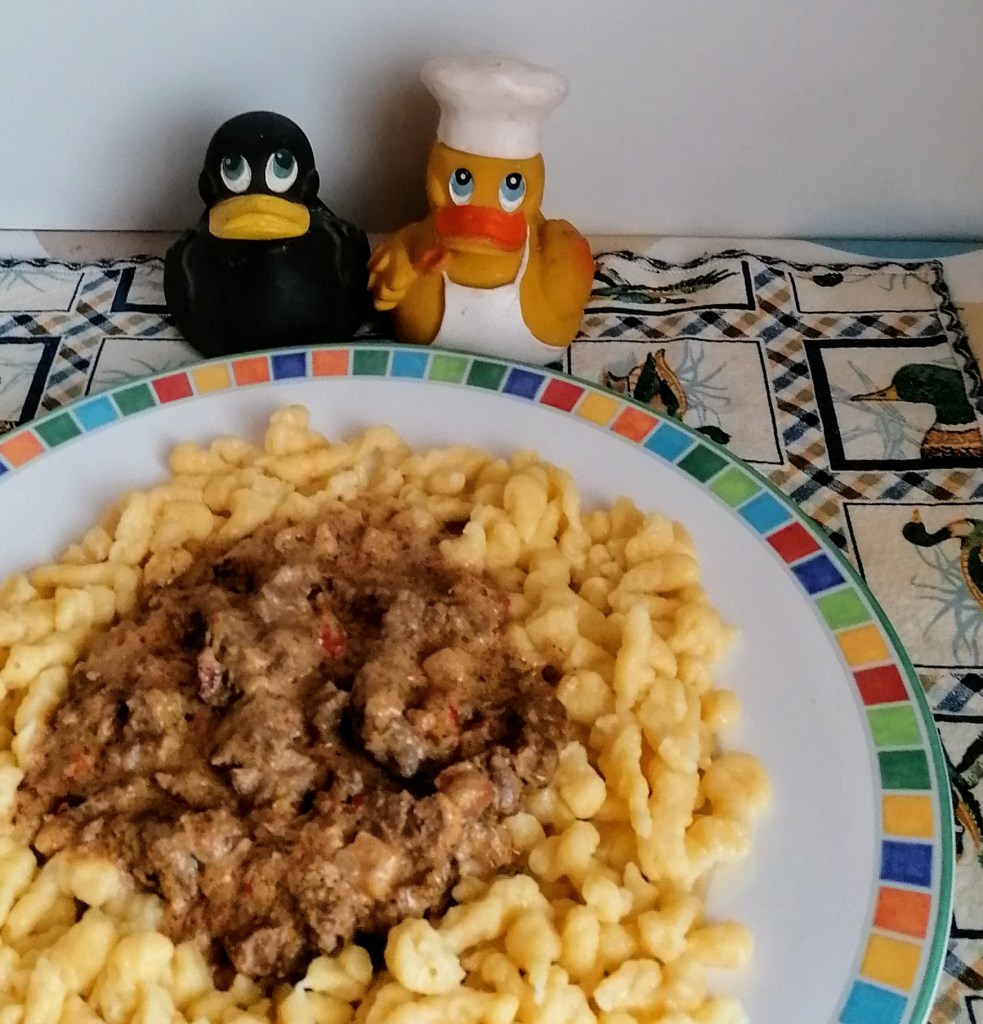
When one thinks of noodles, usually the first association is Italian pasta. However, noodles in many varieties have existed since prehistoric times. One of my my favourite sorts is Spätzle, a South-German type.
Spätzle have existed for centuries and they seem to have originated in the Schwabenland, nowadays the Baden-Württemberg region with capital Stuttgart. The oldest known mention in a document is in the year 1725 but they have existed much longer. Several images from the Middle ages exist, showing people with a Spätzlebrett, a board for making Spätzle: one puts the dough onto it and pushes little pieces of dough into cooking water. Ideally Spätzle are 2-5 cm long and nowadays exist sieve-like appliances to ease their making.
There are several theories about the origin of their name, including a popular theory on the name coming from Italian spezzare – to cut into pieces. The interconnections with other national kitchens are unclear, as several other nations have the same type of noodles under different names, e. g. in Hungary they are called nokedli. What is quite sure is that they were originally a poor man’s dish as they are inexpensive and simple to make.
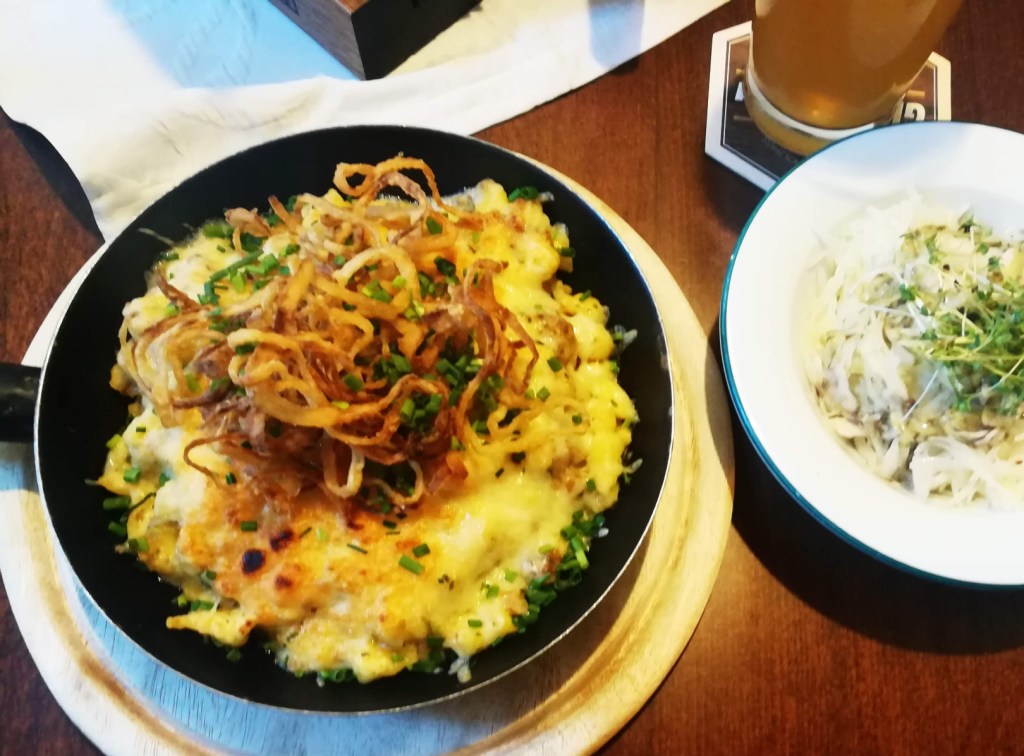
Spätzle are much consumed both in Baden-Württemberg and in Bayern (Bavaria). They can be a side-dish for meat dishes with sauce, or eaten as a main, most frequently baked with cheese and served with fried onions (Käsespätzle mit Röstzwiebeln, my personal absolute top one comfort food, soon I will share my recipe for that).
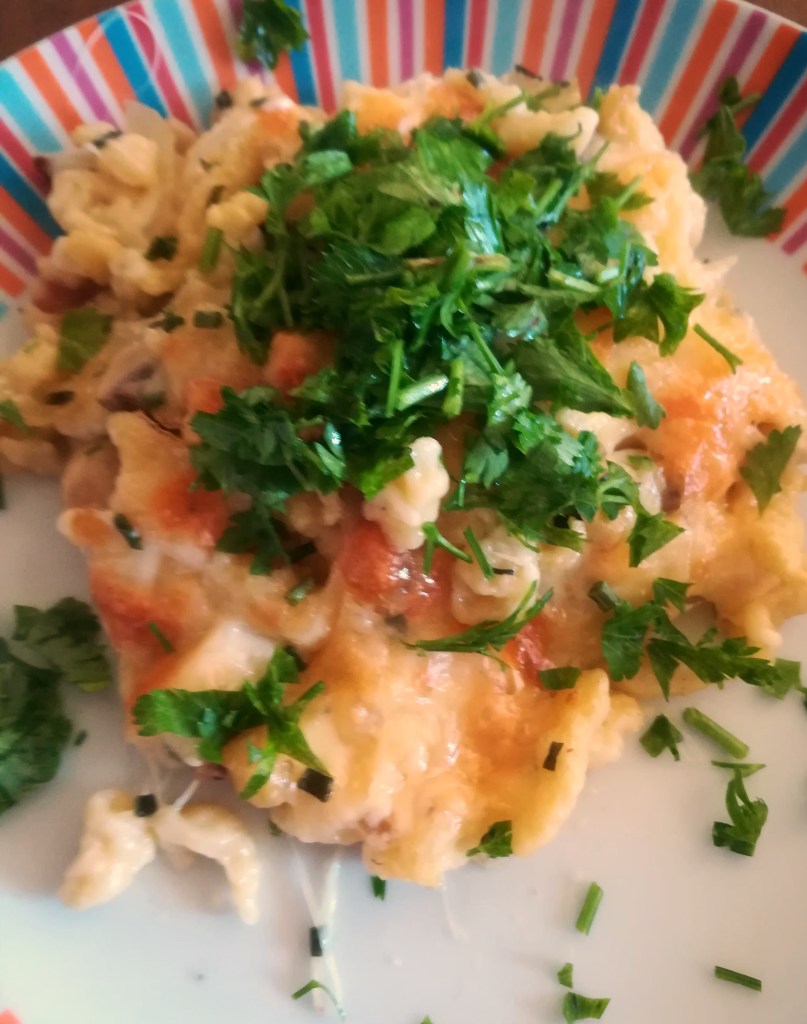
The Spätzle-dough is easy to make: per 100 g flour (ideally coarse-grained wheat flour) you need 1 egg, a pinch of salt and about 40 ml tepid water. Flour and salt are mixed, egg is added and one starts to stir with a wooden spoon with a hole in it, adding water little by little. One needs to stir vigorously until big bubbles burst from it. The dough needs to be only slightly runny, much thicker than pancake dough, but thin enough to be able to drip from the spoon. That’s all!
If you make the dough slightly runnier and let it run in small drops into cooking water you get Knöpfle, the small round brother of Spätzle – like the ones in the top picture (and the video). But no matter – both Spätzle and Knöpfle are so satisfying, I simply cannot transfer into words how much I love them ❤️
 Cooker on the Orient Express
One Comment Add yours