Kitchen ratios – part 1
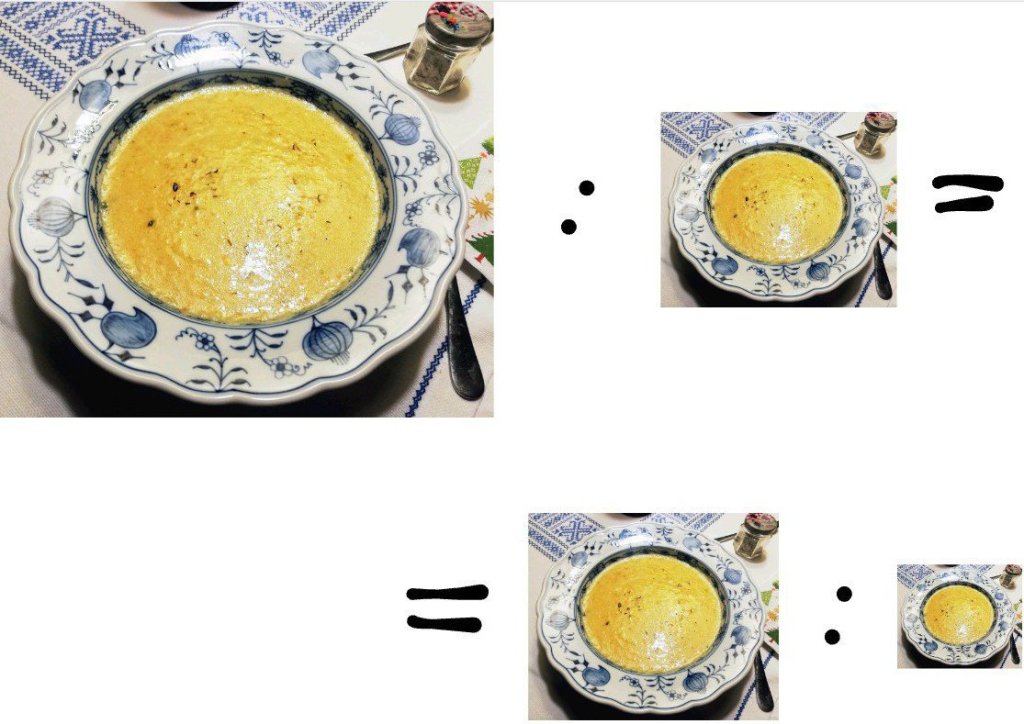
If there is any mathematical topic which you absolutely can’t avoid in preparation of food and drinks, then it is ratios and proportionality. They are used in conversions of units of measure, adapting the recipe to the desired number of servings, and many more.

I plan to write a series of short articles on this topic, each devoted to a different situation when this type of maths is needed in a context including food and drink, but aiming to lead you to an AHA! – moment. Hopefully I will succeed in this, but in worst case everyone will have a quick reference for solving specific mathematical kitchen problems 😁.

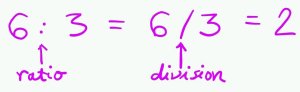
Writing about conversions of lengths from centimeters to inch, I said: Multiply the cm value by 2.54 to get the inch value. I could have said the exactly same thing this way: The ratio between cm and inch value for any given length is always 2.54. This is because ratio is essentially division: Saying 2 inch times 2.54 gives 5.08 cm describes exactly the same relationship between numerical values as does saying that the ratio of 5.08 cm to 2 inch is 2.54 (i.e. 5.08 cm divided by 2 inch is 2.54).
The ratio between two numerical values is the result of their division. When we think and speak of ratio, we think of a relationship, often for a class of values, and use the symbol :, while when the emphasis on calculation, mostly with concrete values, we think of division and use the symbol /. So length in cm : length in inch is a ratio and 5.08 cm / 2 inch is a division, but both can be summarised in a single numerical value 2.54.
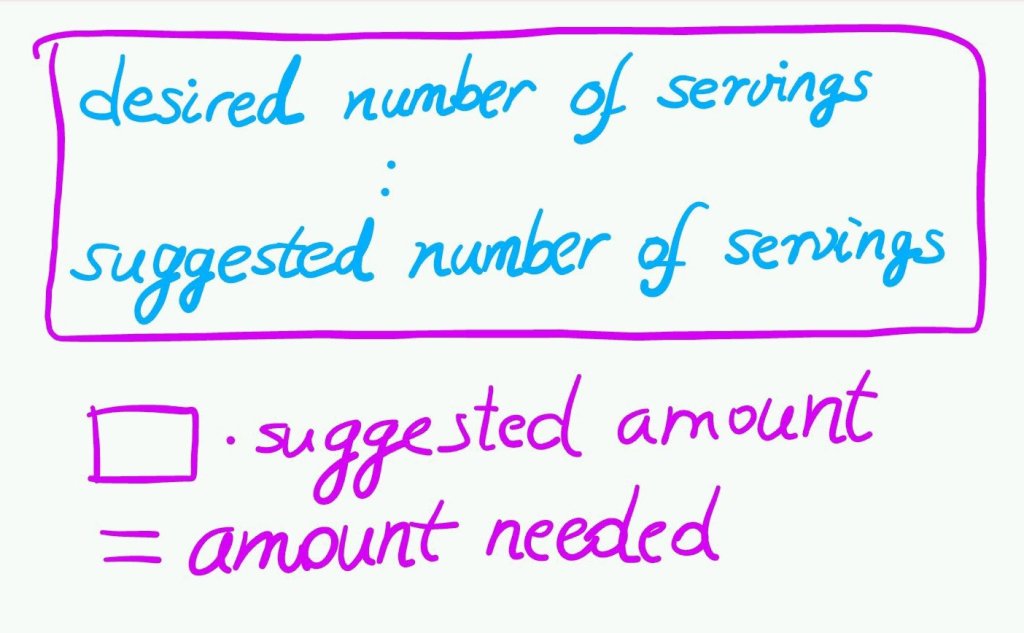
Now, most recipes come with a suggested number of servings, very often it is 4. Then come the amounts of ingredients needed for this suggested number of servings. However, very often we want to make the same recipe for a greater or smaller number of servings. If we want to make a recipe for 2, while it was suggested for 4, I am sure each and every one of you will say: We need half of everything. This is because the desired number of servings (2) divided by the number of serving suggested in recipe (4) has a numerical value (2/4 = 1/2, i. e. 2 is one half of 4) and all the ingredient amounts should obbey the same ratio if we want to have the same end-product.
So, if a recipe suggests 4 servings and needs 4 eggs, 200 g flour and 500 ml milk, but you want to make it for 9 servings, you divide 9 by 4 and get 2.25, then you multiply all amounts by 2.25 to learn that you need 9 eggs, 450 g flour and 1125 ml milk to make it.
Here is a cheat-sheet for quick reference. I will write more on ratios soon, but enough maths for today 😉
.
 Cooker on the Orient Express