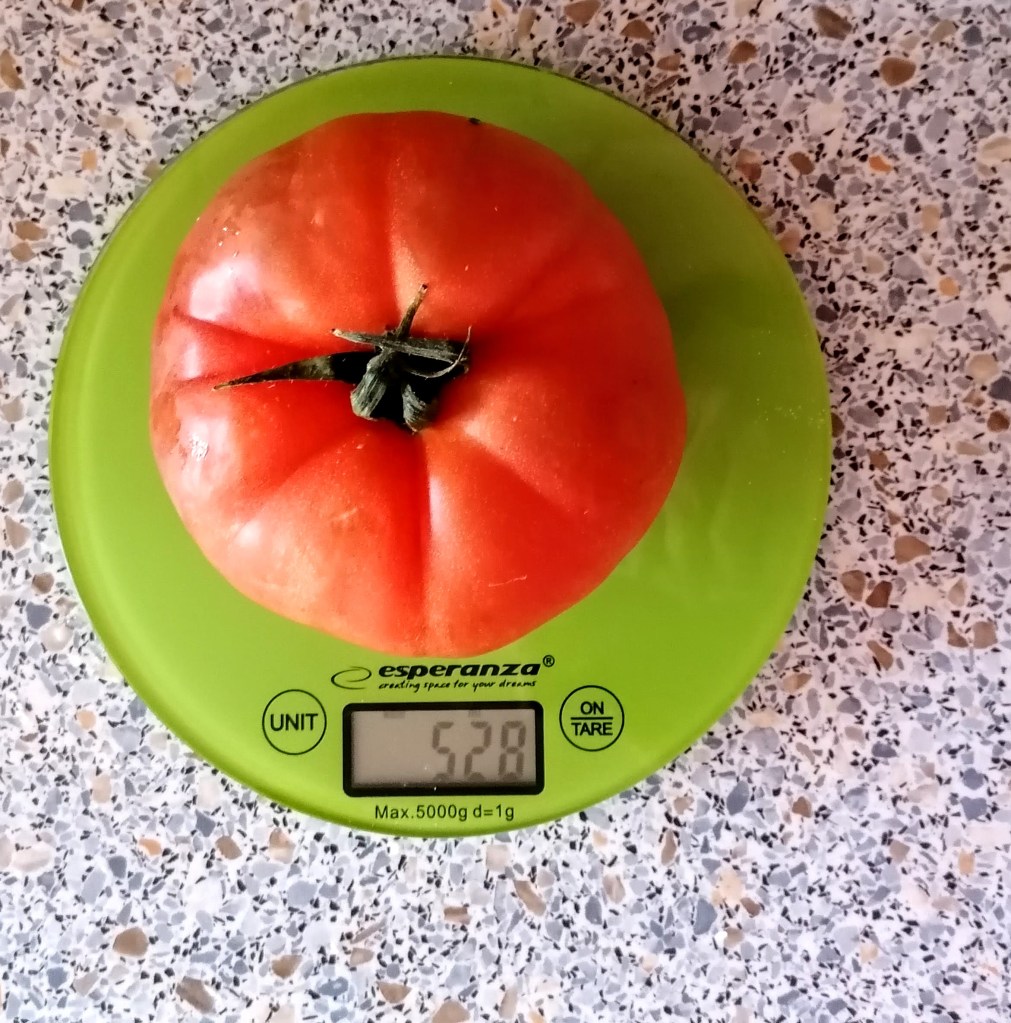
Just as for lengths, this blog also uses metric units of measure – mostly gram (g) and kilogram (kg, 1 kg = 1000 g) – to describe weight (in fact, mass, see note at the bottom of this page).
Btw, many recipes improperly use gr to denote gram. The abbreviation gr however is the unit symbol for grain (which is roughly 15 times less, so 150 gr is, approximately, only 10 gram).

What if you want to use a recipe from this site, but are used to describe weights in pounds (lb) and ounces (oz, 1 lb = 16 oz)? Obviously, you have to calculate.
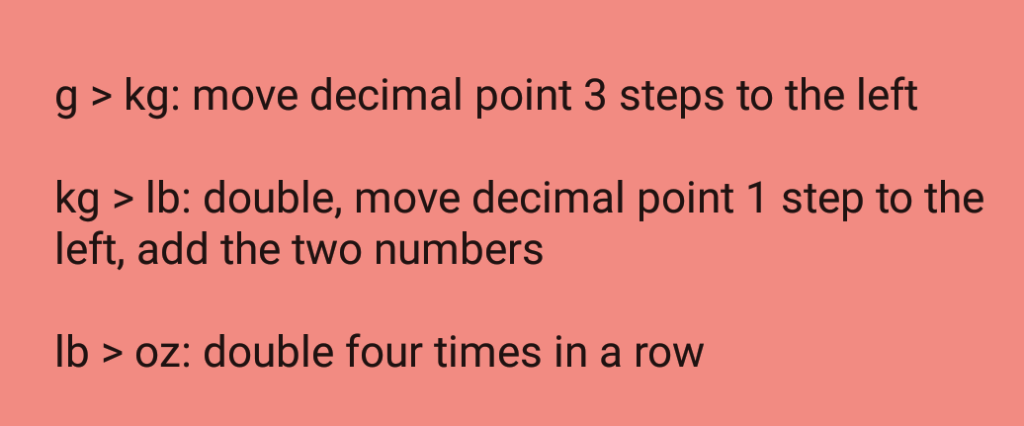
First, learn to convert kg to lb. If you use a calculator, multiply the weight value given in kg by 2.20462442 to get the weight in lb. As in the kitchen you will not be working with hundreds or more kilograms, multiplying by 2.2 suffices. And that can be done quickly even without a calculator!
Say you want to convert 0.75 kg into lb.
- Double the kg value. In our example you get 1.5.
- Move the decimal point one step to the left: 0.15.
- Add the two numbers from steps 1 and 2 to get the result: 0.75 kg is 1.5 + 0.15 = 1.65 lb.
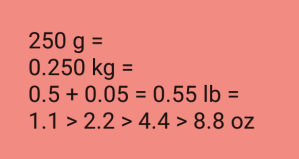
If your original weight was given in g, then before or after (however you prefer) doing the previous calculation move the decimal point 3 steps to the left (which corresponds to dividing by 1000). Here is an example conversion of g into lb: 500 g = 0.5 kg > 1 + 0.1 = 1.1 lb, or 500 g > 1000 + 100 = 1100 > 1.1 lb.
Now, whether you have started from kg or g you have your weight in lb. If you prefer oz, then you have to double your lb value four times (i. e. you multiply by 2*2*2*2 = 16). E. g. 1.1 lb > 2.2 > 4.4 > 8.8 > 17.6 oz.
We wrap all of the above up in a cheat-sheet 😁
Don’t forget! If a number is integer (i.e. written without a decimal point), it is assumed the decimal point is at its end, e.g. 25 = 25. 😊. Moving the decimal point one step to the left (= division by 10) in this case results in 2.5, and in case you move it one step to the right (multiplication by 10), you have to add a 0 at the end to get 250.
Note. It would be more correct to speak of mass than of weight, as mass is a property of matter, while weight measures how strongly gravity acts upon the weighed matter. However, as the strength of gravity does not vary much on the surface of the Earth, it is not too important to distinguish these two in the kitchen context, so we use the scientifically incorrect, but more commonly used term weight when we in fact speak about mass.
 Cooker on the Orient Express